Checkatrade
Helping homeowners and tradespeople connect, book, and get jobs done.
Helping homeowners and tradespeople connect, book, and get jobs done.
Helping homeowners and tradespeople connect, book, and get jobs done.
year
2021–2025
Category
In-house product design
Overview
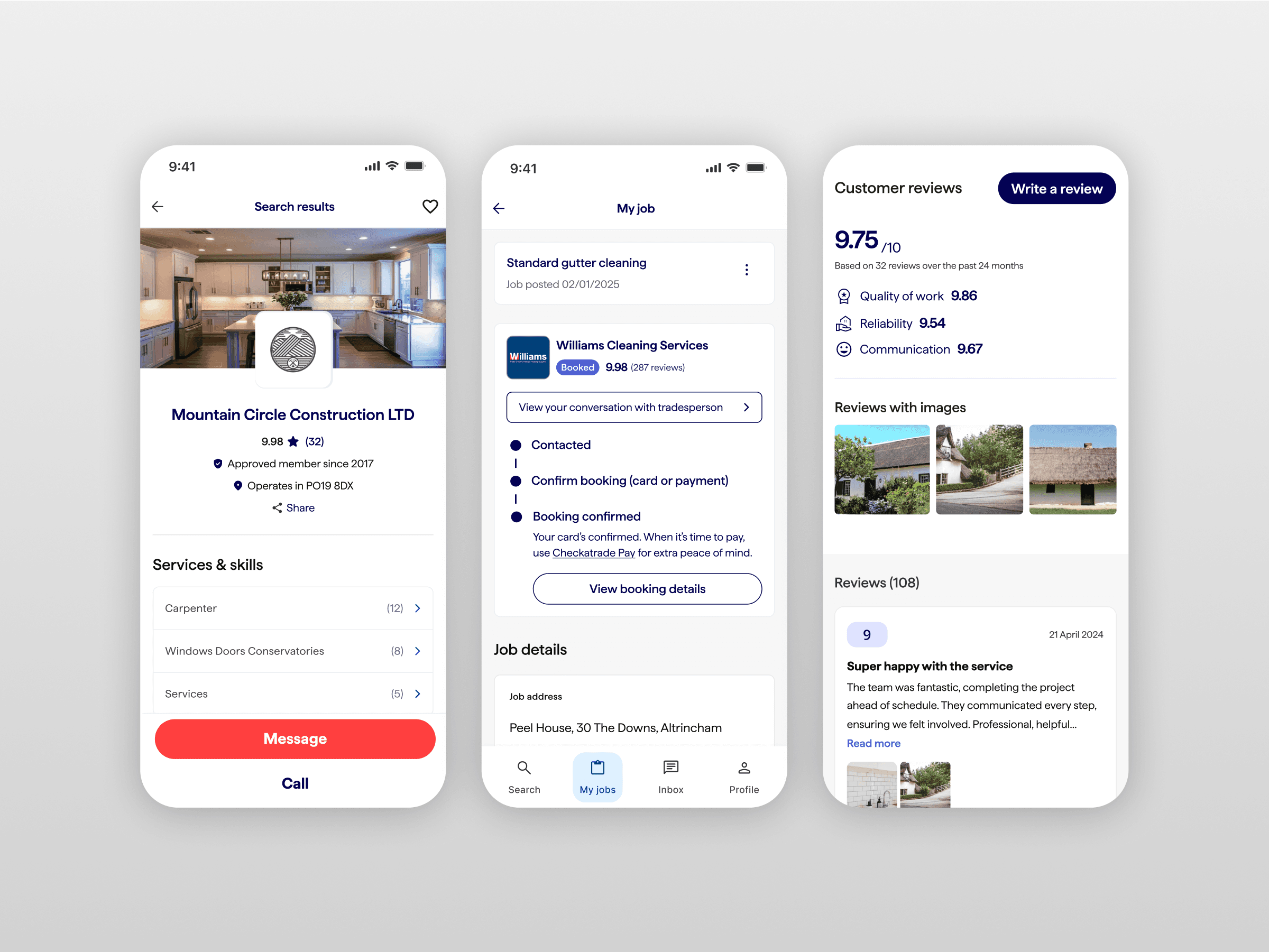
At Checkatrade, I led UX across jobs, booking, and payments — shaping how homeowners and tradespeople connect, build trust, and get work done. From discovery to completion, I designed flows that simplified decisions, reduced friction, and supported a more connected marketplace.
Overview
At Checkatrade, I led UX across jobs, booking, and payments — shaping how homeowners and tradespeople connect, build trust, and get work done. From discovery to completion, I designed flows that simplified decisions, reduced friction, and supported a more connected marketplace.
Overview
At Checkatrade, I led UX across jobs, booking, and payments — shaping how homeowners and tradespeople connect, build trust, and get work done. From discovery to completion, I designed flows that simplified decisions, reduced friction, and supported a more connected marketplace.
Homeowner hub
Designing a central space for homeowners to manage jobs
I led UX for the Homeowner Hub, a new area where customers could track their jobs, re-engage with trades, and understand the status of their projects. The challenge was that most homeowners didn’t realise they even had an account after requesting a quote, which created friction later when trying to follow up, hire, or leave a review.
What I did
Journey & empathy mapping. Mapped out the end-to-end homeowner journey to uncover drop-offs and pain points.
Milestone touchpoints. Designed job status updates to make progress clearer and nudge next actions.
Progressive verification. Introduced stepped account verification to reduce friction and improve account awareness without forcing passwords.
Review & guarantee flows. Designed mechanisms for closing jobs, collecting reviews, and activating the Checkatrade Guarantee.
Future-facing concepts (user tested). Explored prototypes for in-app quote estimations, payments and “Jobs Around Me” discovery.
Impact
Helped homeowners close or progress jobs more confidently, reducing trades waiting on “dead” leads.
Increased review collection rates by tying reviews to guarantee activation.
Provided a scalable foundation for payments, messaging, and richer job management features.
Homeowner hub
Designing a central space for homeowners to manage jobs
I led UX for the Homeowner Hub, a new area where customers could track their jobs, re-engage with trades, and understand the status of their projects. The challenge was that most homeowners didn’t realise they even had an account after requesting a quote, which created friction later when trying to follow up, hire, or leave a review.
What I did
Journey & empathy mapping. Mapped out the end-to-end homeowner journey to uncover drop-offs and pain points.
Milestone touchpoints. Designed job status updates to make progress clearer and nudge next actions.
Progressive verification. Introduced stepped account verification to reduce friction and improve account awareness without forcing passwords.
Review & guarantee flows. Designed mechanisms for closing jobs, collecting reviews, and activating the Checkatrade Guarantee.
Future-facing concepts (user tested). Explored prototypes for in-app quote estimations, payments and “Jobs Around Me” discovery.
Impact
Helped homeowners close or progress jobs more confidently, reducing trades waiting on “dead” leads.
Increased review collection rates by tying reviews to guarantee activation.
Provided a scalable foundation for payments, messaging, and richer job management features.
Homeowner hub
Designing a central space for homeowners to manage jobs
I led UX for the Homeowner Hub, a new area where customers could track their jobs, re-engage with trades, and understand the status of their projects. The challenge was that most homeowners didn’t realise they even had an account after requesting a quote, which created friction later when trying to follow up, hire, or leave a review.
What I did
Journey & empathy mapping. Mapped out the end-to-end homeowner journey to uncover drop-offs and pain points.
Milestone touchpoints. Designed job status updates to make progress clearer and nudge next actions.
Progressive verification. Introduced stepped account verification to reduce friction and improve account awareness without forcing passwords.
Review & guarantee flows. Designed mechanisms for closing jobs, collecting reviews, and activating the Checkatrade Guarantee.
Future-facing concepts (user tested). Explored prototypes for in-app quote estimations, payments and “Jobs Around Me” discovery.
Impact
Helped homeowners close or progress jobs more confidently, reducing trades waiting on “dead” leads.
Increased review collection rates by tying reviews to guarantee activation.
Provided a scalable foundation for payments, messaging, and richer job management features.
Quotes, Invoices & Payments
Unifying fragmented tools into a connected transaction flow
When I joined, quotes, invoices, and payments had been developed in silos, creating inconsistencies and missing links. For example, new chat features clashed with quoting flows, invoices couldn’t link to payments, and statuses didn’t update reliably. This made the overall system harder to use at scale.
What I did
Heuristic audit & documentation. Reviewed quotes, invoices, and payments flows to capture UX issues and inconsistencies.
Prioritisation workshop. Led a stakeholder workshop to document solutions to the audit findings and align on priorities.
UI & flow improvements. Refreshed the payments activity log for clarity, introduced filtering, improved balance visibility, and redesigned the quoting UI for easier item management.
Feature design. Worked on Tap to Pay, off-platform payment links, and one-time payment link creation.
System mapping & status logic. Created flowcharts and rules to define how quotes, invoices, and payments should interact (e.g. partial vs. full payments, declined quotes with linked payments), providing the foundation for a connected system.
Impact
Reduced fragmentation by linking quotes, invoices, and payments into a single traceable flow.
Improved clarity for tradespeople managing payments within the Trade App.
Provided the groundwork for scalable features like deposits, partial payments, and external/manual payment recording.
Quotes, Invoices & Payments
Unifying fragmented tools into a connected transaction flow
When I joined, quotes, invoices, and payments had been developed in silos, creating inconsistencies and missing links. For example, new chat features clashed with quoting flows, invoices couldn’t link to payments, and statuses didn’t update reliably. This made the overall system harder to use at scale.
What I did
Heuristic audit & documentation. Reviewed quotes, invoices, and payments flows to capture UX issues and inconsistencies.
Prioritisation workshop. Led a stakeholder workshop to document solutions to the audit findings and align on priorities.
UI & flow improvements. Refreshed the payments activity log for clarity, introduced filtering, improved balance visibility, and redesigned the quoting UI for easier item management.
Feature design. Worked on Tap to Pay, off-platform payment links, and one-time payment link creation.
System mapping & status logic. Created flowcharts and rules to define how quotes, invoices, and payments should interact (e.g. partial vs. full payments, declined quotes with linked payments), providing the foundation for a connected system.
Impact
Reduced fragmentation by linking quotes, invoices, and payments into a single traceable flow.
Improved clarity for tradespeople managing payments within the Trade App.
Provided the groundwork for scalable features like deposits, partial payments, and external/manual payment recording.
Quotes, Invoices & Payments
Unifying fragmented tools into a connected transaction flow
When I joined, quotes, invoices, and payments had been developed in silos, creating inconsistencies and missing links. For example, new chat features clashed with quoting flows, invoices couldn’t link to payments, and statuses didn’t update reliably. This made the overall system harder to use at scale.
What I did
Heuristic audit & documentation. Reviewed quotes, invoices, and payments flows to capture UX issues and inconsistencies.
Prioritisation workshop. Led a stakeholder workshop to document solutions to the audit findings and align on priorities.
UI & flow improvements. Refreshed the payments activity log for clarity, introduced filtering, improved balance visibility, and redesigned the quoting UI for easier item management.
Feature design. Worked on Tap to Pay, off-platform payment links, and one-time payment link creation.
System mapping & status logic. Created flowcharts and rules to define how quotes, invoices, and payments should interact (e.g. partial vs. full payments, declined quotes with linked payments), providing the foundation for a connected system.
Impact
Reduced fragmentation by linking quotes, invoices, and payments into a single traceable flow.
Improved clarity for tradespeople managing payments within the Trade App.
Provided the groundwork for scalable features like deposits, partial payments, and external/manual payment recording.
Jobs Board
Giving tradespeople more choice in how they find work
Checkatrade’s traditional model sends leads directly to tradespeople — and this remains the core way members get work. The Jobs Board (later branded “Opportunities”) was designed as a complementary option: a place where trades could proactively browse available jobs and fill gaps in their diary, while homeowners still benefited from multiple trades being invited to quote.
What I did
UI design. Designed the Jobs Board tab within the Trade App, reusing and adapting existing job card components to keep it familiar, consistent, and efficient to build. Conducted user testing to validate usability and relevance.
Filters & transparency. Added category, start date, and unread filters; displayed how many trades had already expressed interest.
Lead allocation. Supported mechanics for monthly free leads that renewed each cycle, giving trades a fair and accessible way to try the feature.
Mutual acceptance flow. Designed and tested homeowner emails confirming whether they wanted to share their details with a trade. Conducted comprehension testing on subject lines, button copy, and layouts to ensure clarity and engagement.
Iteration & optimisation. Supported rollout with enhancements such as reminder emails and daily recaps to increase visibility and engagement.
Impact
Validated the potential of a pull-based model alongside the existing lead system.
Provided tradespeople with more freedom to pick work on their own terms.
Delivered a low-cost MVP by reusing existing components, allowing rapid testing and iteration.
Achieved strong engagement: half of eligible members used the Jobs Board monthly, with 70% satisfaction among active users. Non-use was mainly due to time constraints, confirming the model’s value as a complementary channel for filling diary gaps.
Jobs Board
Giving tradespeople more choice in how they find work
Checkatrade’s traditional model sends leads directly to tradespeople — and this remains the core way members get work. The Jobs Board (later branded “Opportunities”) was designed as a complementary option: a place where trades could proactively browse available jobs and fill gaps in their diary, while homeowners still benefited from multiple trades being invited to quote.
What I did
UI design. Designed the Jobs Board tab within the Trade App, reusing and adapting existing job card components to keep it familiar, consistent, and efficient to build. Conducted user testing to validate usability and relevance.
Filters & transparency. Added category, start date, and unread filters; displayed how many trades had already expressed interest.
Lead allocation. Supported mechanics for monthly free leads that renewed each cycle, giving trades a fair and accessible way to try the feature.
Mutual acceptance flow. Designed and tested homeowner emails confirming whether they wanted to share their details with a trade. Conducted comprehension testing on subject lines, button copy, and layouts to ensure clarity and engagement.
Iteration & optimisation. Supported rollout with enhancements such as reminder emails and daily recaps to increase visibility and engagement.
Impact
Validated the potential of a pull-based model alongside the existing lead system.
Provided tradespeople with more freedom to pick work on their own terms.
Delivered a low-cost MVP by reusing existing components, allowing rapid testing and iteration.
Achieved strong engagement: half of eligible members used the Jobs Board monthly, with 70% satisfaction among active users. Non-use was mainly due to time constraints, confirming the model’s value as a complementary channel for filling diary gaps.
Jobs Board
Giving tradespeople more choice in how they find work
Checkatrade’s traditional model sends leads directly to tradespeople — and this remains the core way members get work. The Jobs Board (later branded “Opportunities”) was designed as a complementary option: a place where trades could proactively browse available jobs and fill gaps in their diary, while homeowners still benefited from multiple trades being invited to quote.
What I did
UI design. Designed the Jobs Board tab within the Trade App, reusing and adapting existing job card components to keep it familiar, consistent, and efficient to build. Conducted user testing to validate usability and relevance.
Filters & transparency. Added category, start date, and unread filters; displayed how many trades had already expressed interest.
Lead allocation. Supported mechanics for monthly free leads that renewed each cycle, giving trades a fair and accessible way to try the feature.
Mutual acceptance flow. Designed and tested homeowner emails confirming whether they wanted to share their details with a trade. Conducted comprehension testing on subject lines, button copy, and layouts to ensure clarity and engagement.
Iteration & optimisation. Supported rollout with enhancements such as reminder emails and daily recaps to increase visibility and engagement.
Impact
Validated the potential of a pull-based model alongside the existing lead system.
Provided tradespeople with more freedom to pick work on their own terms.
Delivered a low-cost MVP by reusing existing components, allowing rapid testing and iteration.
Achieved strong engagement: half of eligible members used the Jobs Board monthly, with 70% satisfaction among active users. Non-use was mainly due to time constraints, confirming the model’s value as a complementary channel for filling diary gaps.
Trade app rewrite
Streamlining tradespeople’s core tool for managing work
The Trade App is the main tool tradespeople use to manage their work. Over time, new features were added separately, which made the experience feel a bit disjointed. When the business started planning a move to a new platform, I worked on rethinking the structure of the app so that jobs, quotes, invoices, and payments could connect more smoothly.
What I did
Research synthesis. Reviewed all existing research and grouped tradespeople’s needs into segments, building an Opportunity–Solution Tree to guide product priorities.
Information architecture. Proposed a new sitemap that joined up areas of the app instead of keeping them separate.
Mapped the job lifecycle. Defined how jobs progress from leads to completed work, capturing all the statuses.
Wireframing & prototyping. Created a wireframe prototype of a reimagined Jobs Area that brought leads, active jobs, and past jobs into one place. Reworked the old “More” menu (just a flat list of items) into a structured profile area.
Job card redesign. Delivered a new card layout surfacing property details, statuses, and key actions (quotes, invoices, payments), supporting richer job lifecycle management.
Explored new ideas. Looked at concepts like manual job entry, tasks/events, and a “next best action” homepage.
Impact
Created a framework for unifying the Trade App, connecting previously siloed features into one experience.
Got redesigned job cards shipped, introducing maps and property details, and supporting better job management.
Helped product and engineering see how trade needs could be supported in one place, not scattered across different parts of the app.
Trade app rewrite
Streamlining tradespeople’s core tool for managing work
The Trade App is the main tool tradespeople use to manage their work. Over time, new features were added separately, which made the experience feel a bit disjointed. When the business started planning a move to a new platform, I worked on rethinking the structure of the app so that jobs, quotes, invoices, and payments could connect more smoothly.
What I did
Research synthesis. Reviewed all existing research and grouped tradespeople’s needs into segments, building an Opportunity–Solution Tree to guide product priorities.
Information architecture. Proposed a new sitemap that joined up areas of the app instead of keeping them separate.
Mapped the job lifecycle. Defined how jobs progress from leads to completed work, capturing all the statuses.
Wireframing & prototyping. Created a wireframe prototype of a reimagined Jobs Area that brought leads, active jobs, and past jobs into one place. Reworked the old “More” menu (just a flat list of items) into a structured profile area.
Job card redesign. Delivered a new card layout surfacing property details, statuses, and key actions (quotes, invoices, payments), supporting richer job lifecycle management.
Explored new ideas. Looked at concepts like manual job entry, tasks/events, and a “next best action” homepage.
Impact
Created a framework for unifying the Trade App, connecting previously siloed features into one experience.
Got redesigned job cards shipped, introducing maps and property details, and supporting better job management.
Helped product and engineering see how trade needs could be supported in one place, not scattered across different parts of the app.
Trade app rewrite
Streamlining tradespeople’s core tool for managing work
The Trade App is the main tool tradespeople use to manage their work. Over time, new features were added separately, which made the experience feel a bit disjointed. When the business started planning a move to a new platform, I worked on rethinking the structure of the app so that jobs, quotes, invoices, and payments could connect more smoothly.
What I did
Research synthesis. Reviewed all existing research and grouped tradespeople’s needs into segments, building an Opportunity–Solution Tree to guide product priorities.
Information architecture. Proposed a new sitemap that joined up areas of the app instead of keeping them separate.
Mapped the job lifecycle. Defined how jobs progress from leads to completed work, capturing all the statuses.
Wireframing & prototyping. Created a wireframe prototype of a reimagined Jobs Area that brought leads, active jobs, and past jobs into one place. Reworked the old “More” menu (just a flat list of items) into a structured profile area.
Job card redesign. Delivered a new card layout surfacing property details, statuses, and key actions (quotes, invoices, payments), supporting richer job lifecycle management.
Explored new ideas. Looked at concepts like manual job entry, tasks/events, and a “next best action” homepage.
Impact
Created a framework for unifying the Trade App, connecting previously siloed features into one experience.
Got redesigned job cards shipped, introducing maps and property details, and supporting better job management.
Helped product and engineering see how trade needs could be supported in one place, not scattered across different parts of the app.
Marketplace transformation
Evolving from leads to a true marketplace
Checkatrade began as a lead generation platform: homeowners posted jobs, trades responded, and everything from booking to payment happened off-platform. To grow, the business aimed to evolve into a marketplace model, where jobs could be booked and secured directly on Checkatrade.
I worked on designing and testing new booking flows, helping the business learn what worked (and what didn’t) as we introduced instant booking and card collection for the first time.
What I did
Tested the first idea. Designed an “instant booking” flow where homeowners had to enter card details upfront (before speaking with the trade). Tested with homeowners, which proved the approach was too rigid and didn’t match their mental model.
Proposed a new approach. Designed a revised journey where:
Homeowners can first view a trade’s listing, description, and price.
They can chat with the trade before committing.
The trade confirms the final job price and chooses how funds will be managed.
At that point, once details are clear — the homeowner enters their card details to secure the booking.
Validated with users. Usability testing confirmed that card collection at the confirmation stage felt trustworthy and aligned with expectations.
Ran cross-functional workshops. Co-led sessions with product, UX, and engineering to map user expectations, identify risks, and flag complexity — ensuring the business understood the impact of evolving from lead-gen to marketplace.
Impact
Learned quickly. Early testing showed that upfront card collection didn’t work for homeowners — a valuable failure that prevented the business from launching a broken model.
Aligned with real behaviour. Iterated to a booking flow that matched how people expect to commit: discuss, confirm, then provide payment details.
Supported strategy. Brought Checkatrade a step closer to a marketplace model, by moving bookings and payments onto the platform.
Set the foundation. Work established the base for future marketplace features: like staged payments, guarantees, and new monetisation opportunities.
Marketplace transformation
Evolving from leads to a true marketplace
Checkatrade began as a lead generation platform: homeowners posted jobs, trades responded, and everything from booking to payment happened off-platform. To grow, the business aimed to evolve into a marketplace model, where jobs could be booked and secured directly on Checkatrade.
I worked on designing and testing new booking flows, helping the business learn what worked (and what didn’t) as we introduced instant booking and card collection for the first time.
What I did
Tested the first idea. Designed an “instant booking” flow where homeowners had to enter card details upfront (before speaking with the trade). Tested with homeowners, which proved the approach was too rigid and didn’t match their mental model.
Proposed a new approach. Designed a revised journey where:
Homeowners can first view a trade’s listing, description, and price.
They can chat with the trade before committing.
The trade confirms the final job price and chooses how funds will be managed.
At that point, once details are clear — the homeowner enters their card details to secure the booking.
Validated with users. Usability testing confirmed that card collection at the confirmation stage felt trustworthy and aligned with expectations.
Ran cross-functional workshops. Co-led sessions with product, UX, and engineering to map user expectations, identify risks, and flag complexity — ensuring the business understood the impact of evolving from lead-gen to marketplace.
Impact
Learned quickly. Early testing showed that upfront card collection didn’t work for homeowners — a valuable failure that prevented the business from launching a broken model.
Aligned with real behaviour. Iterated to a booking flow that matched how people expect to commit: discuss, confirm, then provide payment details.
Supported strategy. Brought Checkatrade a step closer to a marketplace model, by moving bookings and payments onto the platform.
Set the foundation. Work established the base for future marketplace features: like staged payments, guarantees, and new monetisation opportunities.
Marketplace transformation
Evolving from leads to a true marketplace
Checkatrade began as a lead generation platform: homeowners posted jobs, trades responded, and everything from booking to payment happened off-platform. To grow, the business aimed to evolve into a marketplace model, where jobs could be booked and secured directly on Checkatrade.
I worked on designing and testing new booking flows, helping the business learn what worked (and what didn’t) as we introduced instant booking and card collection for the first time.
What I did
Tested the first idea. Designed an “instant booking” flow where homeowners had to enter card details upfront (before speaking with the trade). Tested with homeowners, which proved the approach was too rigid and didn’t match their mental model.
Proposed a new approach. Designed a revised journey where:
Homeowners can first view a trade’s listing, description, and price.
They can chat with the trade before committing.
The trade confirms the final job price and chooses how funds will be managed.
At that point, once details are clear — the homeowner enters their card details to secure the booking.
Validated with users. Usability testing confirmed that card collection at the confirmation stage felt trustworthy and aligned with expectations.
Ran cross-functional workshops. Co-led sessions with product, UX, and engineering to map user expectations, identify risks, and flag complexity — ensuring the business understood the impact of evolving from lead-gen to marketplace.
Impact
Learned quickly. Early testing showed that upfront card collection didn’t work for homeowners — a valuable failure that prevented the business from launching a broken model.
Aligned with real behaviour. Iterated to a booking flow that matched how people expect to commit: discuss, confirm, then provide payment details.
Supported strategy. Brought Checkatrade a step closer to a marketplace model, by moving bookings and payments onto the platform.
Set the foundation. Work established the base for future marketplace features: like staged payments, guarantees, and new monetisation opportunities.